
Case studies
Real findings, disclosed and fixed.
Security assessments and coordinated disclosures from the Bugb team — what we found, how it was fixed, and what changed.
From a Codebase to Proven Findings, With One Request
An illustrative small-team workflow: Bravos starts with an invoicing application's codebase and no prepared environment, sets up a local copy, orchestrates GuardLink and Cert-X-Gen, and returns proven issues the developers fix in one sprint.
- 2 in this example
- Vulnerabilities
- One example sprint
- Time to fix
- Codebase only
- Starting Point
- Observed on a local app
- Evidence

Financial Institution Security Overhaul
Comprehensive security assessment for a major bank revealed critical vulnerabilities in their infrastructure and web applications, leading to a complete security transformation.
CVE-2024-50562: Session Hijacking Vulnerability in Fortinet Web Client
BugB Technologies discovered CVE-2024-50562, a critical session management vulnerability in Fortinet's SSL-VPN Web Client that allowed persistent session hijacking through inadequate token invalidation. This breakthrough discovery during independent security research demonstrates the power of manual security testing in uncovering sophisticated authentication bypass vulnerabilities.
Distributed Infrastructure Security at Philips
A proactive security assessment led to the discovery of a critical exposure in Philips's distributed coordination system, helping prevent unauthorized backend access and enabling enterprise-wide remediation.
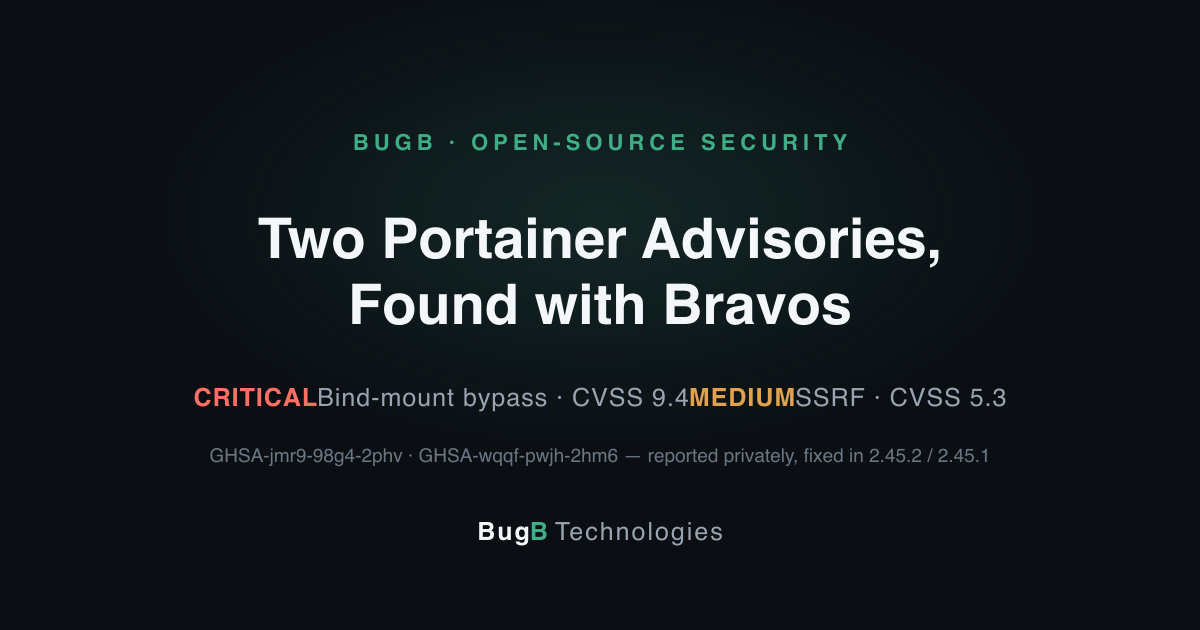
Two Portainer Advisories: Critical Bind-Mount Bypass and SSRF
Portainer published two security advisories on 8 October 2026 that credit Bugb among many independent reporters: a critical non-admin bind-mount restriction bypass (GHSA-jmr9-98g4-2phv, CVSS 9.4) and a server-side request forgery across multiple outbound features (GHSA-wqqf-pwjh-2hm6, CVSS 5.3). Both were found with Bravos, Bugb's whitebox pentesting tool, and reported privately through GitHub's security advisory process.
One Pull Request, One Shared Security Map
An illustrative SaaS workflow: developers and security use GuardLink's in-code threat model to catch two unsafe paths before merge, then use Cert-X-Gen to prove the fixes on a running build. Bravos orchestrates the loop.
A Fix Is Not Closed Until the Running App Proves It
An illustrative platform and security pairing: GuardLink traces an archive upload to a background file write, a developer fixes the missing boundary, and Cert-X-Gen verifies the result. Bravos orchestrates a shared, evidence-led loop in the pull request.